giovedì 17 settembre 2020

Intervista da Venere

Nei giorni scorsi sono state rilevate tracce di Fosfina nell'atmosfera di Venere.

Mi sono quindi deciso a pubblicare il contenuto di un'intervista al sig. qLtnfISppO che sono riuscito ad ottenere in esclusiva.

Ecco la trascrizione:

Intervista.pdf


😅

domenica 6 settembre 2020

GEIGER-MULLER

 Per curiosità

Rilevatore e registratore di raggi cosmici (Muoni).  Si tratta di un circuito realizzato con parti di recupero, per alimentare due tubi geiger-muller (a 400V) e di una scheda sperimentale con il controllo dell'alta tensione e con il codice per rilevare eventi di coincidenza e raccogliere i tempi di arrivo delle particelle.  Tutti i parametri sono visualizzati sul piccolo display alfanumerico.  
A causa dell'area limitata dei sensori, stanotte sono stati rilevati solo 5 eventi.  Con i tubi in arrivo, di area maggiore, mi aspetto più acquisizioni.
 I muoni sono particelle secondarie generate dall'impatto di protoni e particelle alfa (al 99% della velocità della luce) con le molecole d'aria dell'alta atmosfera.  Queste particelle sono generate da eventi cosmici energetici giganti come le esplosioni di Supernove o la caduta di materiale nei Buchi Neri.  L'energia è enorme: un singolo minuscolo Protone trasporta l'energia di una palla da baseball a 90 km/h.  I muoni stessi viaggiano quasi alla velocità della luce.  Per rilevarli, ho bisogno di correlare il segnale degli impulsi da entrambi i tubi mentre il Muone, con la giusta traiettoria, li colpisce.
 

Summer homeworks. DIY: cosmic rays (Muons) detector and recorder. A "spare parts" circuit to power the geiger-muller tubes (400V) and a Discovery STM32L152 with the PI controller of the high voltage and the hw with the code to detect coincidence events and collect the timing, is shown. All parameters are shown on the alphanumeric display. Due to the limited area of the tubes, only 5 events in 6 hours were detected during night test yesterday. With incoming wider area tubes I expect more captures. Muons are secondary particles generated from the impact of super high speed Protons and Alpha particles (99% of the speed of light) with the air molecules of upper atmosphere. These particles are generated from giant energetic cosmic events like supernova explosions. The energy is enormous: a single tiny Proton carries the energy of a baseball ball at 90km/h (56mph). Muons themselves travel almost at the speed of light. To detect them, I need to correlate the pulse signal from both the tubes as the Muon, with the right trajectory, hits them. The hunt is open.


lunedì 24 giugno 2019

The Embers under the Ashes (la brace sotto la cenere)

Fleishmann e Pons

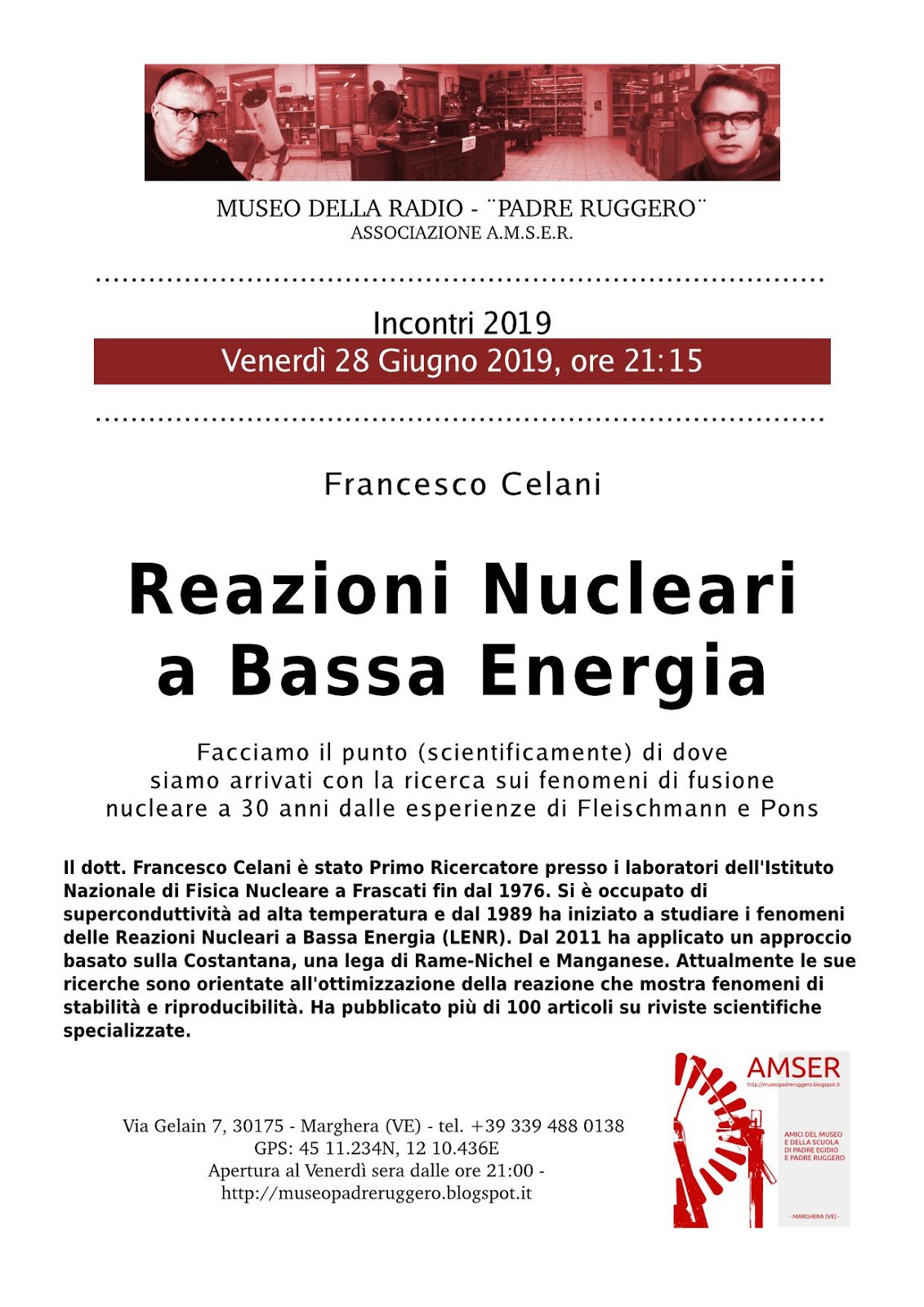
Sono passati 30 anni da quando, nel 1989, due ricercatori inglesi Martin Fleishmann e Stanley Pons, annunciarono al mondo di aver osservato un fenomeno di produzione anomala di energia dall'elettrolisi di una soluzione di acqua pesante con elettrodi di palladio. Probabilmente l'annuncio che ha scaturito la coda di polemiche, aspettative e vera ricerca può lunga della storia. Una storia che non è ancora finita.
Per capire il lato scientifico di questa ricerca, ho invitato il dott. Francesco Celani, forse il ricercatore più tenace che abbiamo, per una conferenza al Museo di Marghera.
Sono proprio curioso di ascoltare la storia che ci racconterà ed il futuro che ci aspetta.


domenica 16 giugno 2019

Artificial Intelligence

What's next?

How machine learning works and what do we have to expect from A.I. development?
There are opportunities but also risks.
In 2000 year I participated to the development of a quite big Neural Network and Expert System aimed to help doctors in EEG analysis and Epileptic Seizures identification and classification. It worked in an amazing way: we collected more than 10000 samples of EEG traces with specific features (normal samples and anomaly samples) and artifacts. We trained the huge NN and arrived to a complete report with EEG measure (energy over bands) and characterization.
However time was too early and commercial exploitation was ineffective due to marketing poor knowledge and poor vision.
Now time has come.
A.I. is everywhere, from cars to washing-machines.
And probably in weapons, also.
To better understand the state-of-the-art, I invited the Associate Professor at Padua University, Silvana Badaloni, for a public conference on A.I..
Expecting her to show us what's next.


sabato 12 maggio 2018

Un arcobaleno da una singola goccia


Una goccia d'acqua colorata (A single colorful droplet)

May a crystal clear drop of water be colorful? The answer is yes! Rainbow is the proof. But looking at the rainbow we never realize that those wonderful set of colors comes from single drops. Each drop is seen with different angles and this difference is the color. Larger view angles make the drops red, smaller view angles make the drops blue. To better understand the phenomena have a look to the document I wrote some time ago and now reviewed. See this document.


...
During the night some dew formed in the grass. The morning after, while I was walking, I noticed a small spot of colored light in the grass with the tail of my eyes. I stopped myself and I turned my head toward it. No mistakes: that was the rainbow light from a single droplet, red on one side and blue on the other! I run and stumbled into home looking for my camera. I went out trying to find back the position: it was extremely critical! As expected the angle through which I could see the colored drop was very small and the distance to the drop was only a couple of meters. But the spot was so bright! I took the camera and aimed it to the light source in the grass. What a disappointment! No spotlight in the camera! How was it possible! With my eye the light was clear and bright but with the camera, nothing! Then I noticed that I could see the light only with one eye at time. Now my guess is that the eye, with its small pupil, records the light from a very small angle while the camera, with a wide angle lens, collects the light from a wider angle and no colored spots appears. Only 1.74° separate the red ray from the blue ray. So to record the light I used a trick: blur the image, set it out of focus! Doing so, the angle of details cover a much larger area on the sensor: rays from small angles hit the sensor surface at larger distances and… the rainbow magically appeared. A rainbow from a single drop! 


sabato 14 ottobre 2017

Crittografia: come Alice e Bob si scambiarono le chiavi in piazza

Diffie-Hellman-Merkle key exchange

In questo post (testo inizialmente in lingua inglese) descrivo la procedura utilizzata durante le prime fasi del protocollo https, e che permette a due corrispondenti di negoziare una chiave di codifica segreta utilizzando un canale di comunicazione non sicuro. Il testo PDF è disponibile in Diffie-Hellman-Merkle.

In this post I describe the procedure used during initial phase of https protocol, which enable two correspondents to negotiate a secret key to encrypt messages using unsecure channel. PDF text is available at the link Diffie-Hellman-Merkle.

domenica 27 agosto 2017

Crittografia -

Crypto-Tool

In questi caldi giorni d'agosto ho trascorso parte del tempo delle mie vacanze a studiare un argomento che mi ha sempre interessato: la crittografia.
Per farlo, ho acquistato un bel volume, "Understanding Cryptography" di Christof Paar che affronta in modo semplice ma completo (si tratta del corso universitario dell'Università di Bochum-RUR) i temi della crittografia moderna: RSA, DH, ECC, AES, DES ecc. e tutte le implicazioni teoriche e le tecniche di elaborazione.
Per esplorare questi argomenti, ho scritto del codice (QT) che utilizza la libreria GMP per il calcolo con numeri grandi.
L'uso di questo codice mi ha aiutato moltissimo a capire le proprietà e i limiti degli agoritmi crittografici.
Prossimamente pubblicherò su questo blog i sorgenti.


Cryptography is OK, but also the Greek sea!
A PDF file is available here for download. English only.
Crypto-Tool PDF

domenica 12 febbraio 2017

Astro-Versi

Incontro al Liceo Berto di Mogliano Veneto

L'evento è organizzato dal Circolo Culturale "G. Galilei" di Mogliano Veneto in collaborazione con SOMS, l'Assessorato alla Cultura del Comune di Mogliano Veneto, il Liceo "G. Berto" ed il Circolo degli Astrofili di Mestre "G. Ruggieri", di cui faccio parte.
Venerdì 24 febbraio parleremo di Cielo e Miti, alternando ai testi classici le informazioni scientifiche.
Appuntamento all'aula magna del Liceo a Mogliano.


martedì 10 gennaio 2017

CIBOTRON

Intervista dal futuro

Come mangeremo nel futuro? Ma soprattutto "cosa" mangeremo?
La crescita della popolazione mondiale richiede di trovare una soluzione al problema della nutrizione che sia compatibile con le risorse del Pianeta.
Con l'amico Fabio Roncato, artista eclettico e visionario, ci siamo divertiti ad esplorare una soluzione in una sorta di intervista Cosplay futuristica.
Giusto per divertimento... (versione in italiano)

Gianpietro e Fabio
https://drive.google.com/open?id=0B46kIc2y96X7ZTYyYjlzTmJPOHM


sabato 24 dicembre 2016

Nuove sfide

CAMBIAMENTI

Dopo 21 anni trascorsi a disegnare dispositivi medicali per la neurofisiologia (sistemi di acquisizione, stimolazione, interfacce, ecc.) è arrivato il momento di dare una svolta e vedere se è possibile trasferire queste conoscenze in un settore completamente diverso.
Dal primo gennaio 2017 il mio ambito di lavoro sarà quello denominato HVAC (riscaldamento e condizionamento).
Una sfida interessante e resa più gradevole dalla squadra di persone che ho la fortuna di incontrare.
Un saluto affettuoso ai miei ex colleghi di lavoro (Micromed S.p.A.).